Memory, Speech, and Language
How does the brain perceive, store, and produce language?
Overview
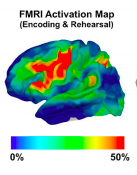
A longstanding line of research in the lab investigates the neural basis of verbal working memory and speech processing. We study how the brain’s auditory and motor systems interact to support the short-term retention and rehearsal of speech, and how phonological representations are organized in the brain.
Key Questions
- What are the neural mechanisms of verbal rehearsal?
- How do auditory dorsal and ventral streams contribute to working memory?
- How are phonological features represented in auditory and motor cortex?
Selected Publications
- Buchsbaum, B. R., & D’Esposito, M. (2019). A sensorimotor view of verbal working memory. Cortex. doi:10.1016/j.cortex.2018.11.010
- Du, Y., Buchsbaum, B. R., Grady, C., & Alain, C. (2016). Increased activity in frontal motor cortex compensates impaired speech perception in older adults. Nature Communications. doi:10.1038/ncomms12241
- Arsenault, J. S., & Buchsbaum, B. R. (2016). No evidence of somatotopic place of articulation feature mapping in motor cortex during passive speech perception. Psychonomic Bulletin & Review. doi:10.3758/s13423-015-0988-z
- Arsenault, J. S., & Buchsbaum, B. R. (2015). Distributed neural representations of phonological features during speech perception. Journal of Neuroscience. doi:10.1523/JNEUROSCI.2454-14.2015
- Fegen, D., Buchsbaum, B. R., & D’Esposito, M. (2015). The effect of rehearsal rate and memory load on verbal working memory. NeuroImage. doi:10.1016/j.neuroimage.2014.10.034
- Buchsbaum, B. R., & D’Esposito, M. (2008). The search for the phonological store: From loop to convolution. Journal of Cognitive Neuroscience. doi:10.1162/jocn.2008.20501
- Buchsbaum, B. R., Olsen, R. K., Koch, P. F., & Berman, K. F. (2005). Human dorsal and ventral auditory streams subserve rehearsal-based and echoic processes during verbal working memory. Neuron. doi:10.1016/J.NEURON.2005.09.029
Code
- rMVPA — R package for multivariate pattern analysis of fMRI data